
WHAT IS GALUNGAN CEREMONY?
Galungan Ceremony in Bali: The Celebration of Dharma over Adharma
What is Galungan?
Galungan is one of the most important religious celebrations in Bali, symbolizing the victory of Dharma (good) over Adharma (evil). It marks the time when ancestral spirits (pitara) are believed to return to the earth to visit their descendants. During this sacred period, Balinese people express gratitude, harmony, and balance in life through prayers and offerings.
Galungan occurs every 210 days, following the Balinese Pawukon calendar, always on Wednesday (Buda Kliwon Dungulan). The celebration lasts for 10 days, ending with Kuningan Day, when the spirits return to heaven.
The Meaning Behind the Celebration
At its core, Galungan is about spiritual reflection and balance. The Balinese believe that life is a constant struggle between good and evil forces. By celebrating Galungan, they renew their commitment to righteousness (dharma), gratitude, and family unity.
The festival also represents the day when the supreme god Ida Sang Hyang Widhi Wasa is believed to descend to bless the world.
The Deeper Meaning of Galungan
At its heart, Galungan is not just a religious event — it’s a reminder of life’s balance.
It teaches the constant struggle between good and evil, light and darkness, and encourages everyone to maintain harmony in all aspects of life.
The festival embodies the Balinese philosophy of Tri Hita Karana — the three causes of well-being:
-
Harmony with God (parhyangan),
-
Harmony among people (pawongan),
-
Harmony with nature (palemahan).
WHEN ITS BEGIN?
But few visitors know that the journey to Galungan doesn’t begin on the day itself — it actually starts 35 days earlier, on Tumpek Wariga, a special day dedicated to nature and the trees.
1. Tumpek Wariga: Honoring the Plants and Trees
Tumpek Wariga (also known as Tumpek Bubuh) marks the first preparation day leading up to Galungan.
It falls 25 days before Galungan, on Saturday (Saniscara Kliwon Wariga).
On this day, Balinese people make offerings to plants, trees, and nature spirits. They sprinkle offerings made of rice flour (bubuh), betel leaves, and flowers at the base of trees, especially fruit trees, while praying for them to bear abundant fruit.
🌱 Meaning:
Tumpek Wariga reminds people to respect nature, as it provides the food and materials needed for Galungan offerings. It reflects the Balinese philosophy of Tri Hita Karana — maintaining harmony between humans, nature, and the divine.
The Sacred 10-Day Preparation Before Galungan
After Tumpek Wariga, the Balinese calendar continues with a series of important days before Galungan. Each day holds symbolic meaning that leads to spiritual readiness.
2. Sugihan Jawa (6 days before Galungan)
This is the day to purify the universe and the environment (bhuana agung). Offerings are made to the gods to cleanse nature and the surroundings.
3. Sugihan Bali (5 days before Galungan)
While Sugihan Jawa focuses on the external world, Sugihan Bali is about purifying the inner self (bhuana alit).
Balinese people pray and prepare spiritually, cleansing the mind and heart before welcoming the ancestors.
4. The Week of Galungan
The real intensity begins in the week of Galungan. Every day before the main ceremony is filled with rituals and deep meaning.
a. Penyekeban (3 days before Galungan)
The word penyekeban means “to cover.” Families start preparing offerings and cover ripening fruits and bananas that will be used in ceremonies.
It represents self-control — holding back negative emotions and desires.
b. Penyajahan (2 days before Galungan)
This is the day of making traditional cakes (jaja) and completing offerings for the ancestors. Balinese women are busy in the kitchen, preparing sacred food and beautiful offerings.
c. Penampahan Galungan (1 day before Galungan)
A crucial day when pigs and chickens are sacrificed (symbolically or literally) to prepare dishes like lawar and satay.
The meaning behind it is the victory over animal instincts — conquering greed, anger, and ego inside ourselves.
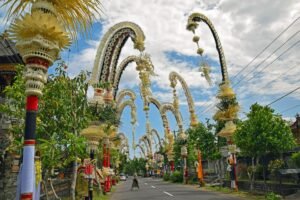
Families also start decorating their homes and erecting the beautiful penjor, tall bamboo poles with coconut leaves, fruits, and rice that line the streets of Bali.
5. Galungan Day: The Victory of Dharma
Galungan Day falls on Wednesday (Buda Kliwon Dungulan).
It’s the main celebration — the day when the gods and ancestral spirits descend to Earth.
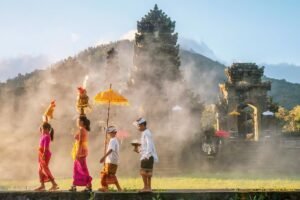
Balinese Hindus wear their best traditional attire and visit family temples (sanggah kemulan) and community temples (pura desa or pura puseh) with colorful offerings.
Every home is beautifully decorated with a penjor in front — symbolizing prosperity and Mount Agung, the sacred mountain of the gods.
✨ Spiritual meaning:
Galungan reminds people that good (Dharma) always prevails over evil (Adharma). It is a day of joy, gratitude, and spiritual victory.
6. The Days After Galungan
The celebration doesn’t end on Galungan. The following days continue the spiritual cycle:
a. Manis Galungan (Thursday)
A joyful day for visiting relatives, friends, and enjoying traditional food. It’s a day to share happiness and gratitude.
b. Pamaridan Guru (Friday)
Dedicated to honoring teachers and spiritual guides. Offerings are made to express gratitude for wisdom and knowledge.
c. Umanis Galungan to Pahing Galungan
In the days that follow, families may continue visiting temples and relatives, maintaining spiritual connection and togetherness.
7. Kuningan Day: Farewell to the Ancestors
Kuningan comes 10 days after Galungan (on Saturday, Saniscara Kliwon Kuningan).
It marks the return of ancestral spirits to heaven after their 10-day visit to Earth.
Offerings on this day are unique — they include yellow rice (nasi kuning), symbolizing prosperity and holiness, along with endongan (small decorative bags), tamiang (round ornaments), and ketupat (woven rice cakes).
Ceremonies are held before noon, as it is believed that by midday, the ancestral spirits have already departed back to heaven.
WHAT YOU CAN EXPECT DURING THE GALUNGAN FESTIVAL?
Experiencing Galungan as a Visitor
For travelers visiting Bali during Galungan, it’s one of the most beautiful times to experience authentic Balinese life.
You’ll see:
-
Streets lined with majestic penjor
-
Families in traditional white attire visiting temples
-
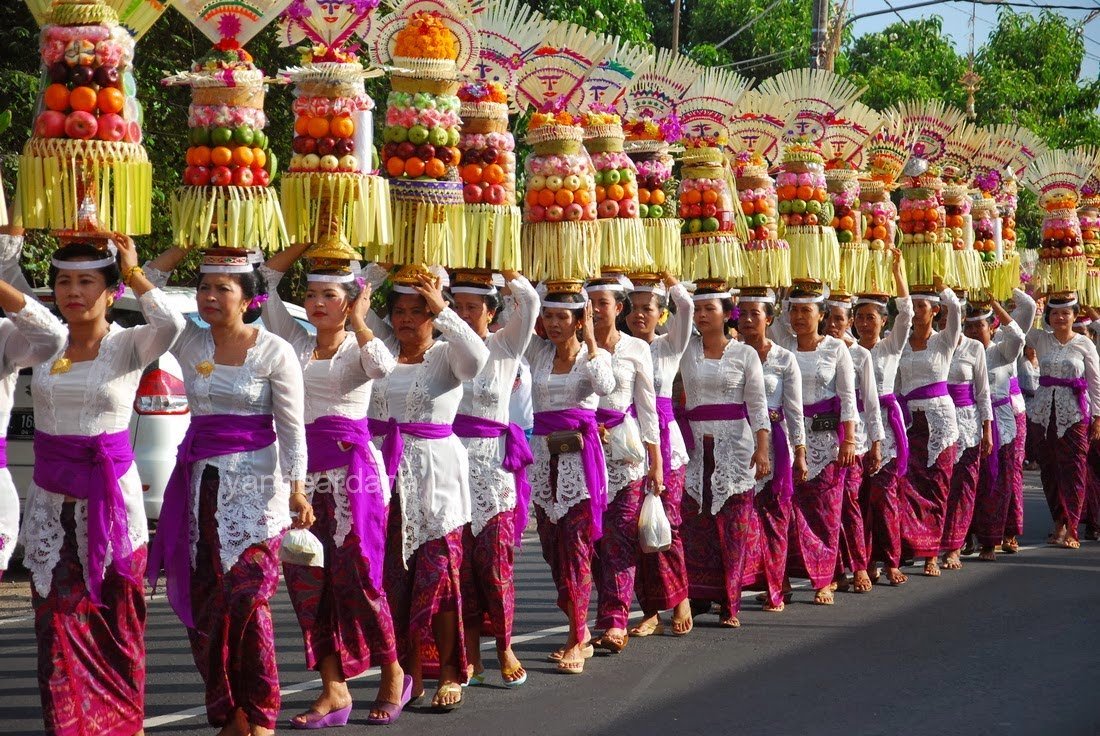
Women carrying colorful offerings on their heads
-
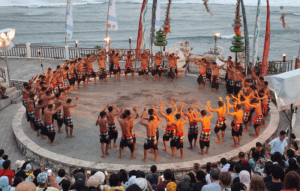
The rhythmic sounds of gamelan and kidung (sacred songs)
Penjor: The Icon of Galungan
The penjor is one of the most recognizable symbols during Galungan. It is a tall, curved bamboo pole decorated with:
-
Young coconut leaves
-
Rice grains
-
Fruits
-
Traditional cakes
-
Sacred cloths
Each element carries spiritual meaning — gratitude to nature, fertility, and the blessings of prosperity. The elegant curve represents Mount Agung, the center of spiritual energy in Bali.